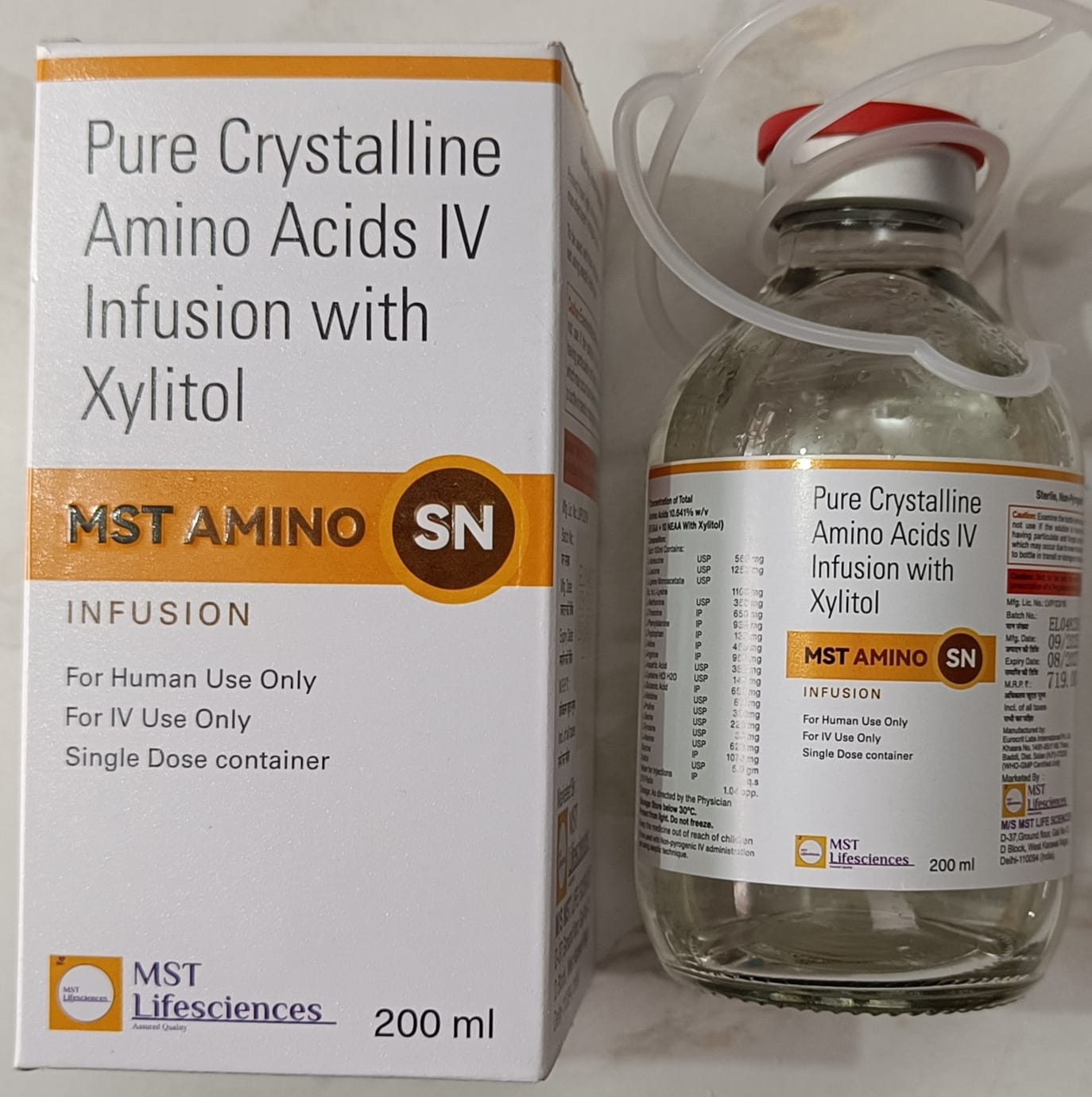
MST AMINO-SN INJECTION By MST LifeSciences | ₹ 719
Key Ingredients
Introduction About MST
AMINO-SN INJECTION
MST Amino-SN Injection is used in hypermetabolic states
requiring protein supplementation and in pregnancy complications due to
nutritional deficiency. It contains L-Histidine, L-Isoleucine, L-Leucine,
L-Lysine, L-Methionine, L-Phenylalanine, L-Threonine, L-Tryptophan, L-Valine,
and Xylitol which belongs to the group of medicines called Amino acids, which
help in the growth, repair of body tissues, breakdown of food, and regulation
of many other body functions.
During pregnancy, amino acids serve as important
precursors for fetal development and growth and the development of the
metabolic cyclic pathways between the placenta and foetus. It is also essential
for the biosynthesis of proteins, nucleotides, and neurotransmitters.
Before using MST Amino-SN Injection, inform your doctor if you have any
pre-existing disease conditions or if you are pregnant, planning to become
pregnant, or breastfeeding. Consult your doctor if you experience any side
effects after using MST Amino-SN Injection
Uses Of MST AMINO-SN INJECTION
·
In a hypermetabolic state requiring protein
supplementation
·
Pregnancy complications due to nutritional deficiency
How MST AMINO-SN INJECTION Works
MST Amino-SN Injection contains amino
acids, which help in the growth, repair of body tissues, breakdown of food, and
regulation of many other body functions. During pregnancy, amino acids serve as
important precursors for fetal development and growth and the development of
the metabolic cyclic pathways between the placenta and foetus. It is also
essential for the biosynthesis of proteins, nucleotides, and neurotransmitters.
Interactions
A.
Drug-Drug Interactions:
Inform your
physician if you are taking, have taken, or might take any other medication,
including prescription, non-prescription, and herbal medicines.
Overdose:
MST Amino-sn
Injection will be given to you only by a doctor or nurse in a hospital, so they
are unlikely to result in an overdose. However, if you feel that the effect of
this medicine is too strong, then please consult your doctor or nurse
immediately.
Others
Interaction
between MST Amino-SN and medications occur in three main ways; physiological
interactions that occur at all times, altered behaviour of medications owing to
the complications of the presenting condition or sub. optimal nutritional
support and direct chemical interaction in the tubing during administration.
Mixing of medications with PN in administration lines should be avoided unless
validated by the manufacturer or accredited laboratory. Medications known to
affect plasma protein binding of bilirubin should be avoided in parenterally
fed newborn patients with severe hyperbilirubinaemia. MST Amino-SN Infusion
should not be administered along with Mannitol. Mannitol being an osmotic
diuretic, the infused will be rapidly excreted from the body.
Usage in Pregnancy
The
use of MST Amino-SN during pregnancy is a matter of caution:
Oral supplementation of AAs during pregnancy could be an
effective—and relatively safe—therapeutic or prophylactic solution to improving
perinatal and long-term health. The arginine family, BCAAs, and methyl donors
form three interesting supplementation groups by virtue of their influence on
fetal growth.
· Consult a doctor: It is crucial to consult
your attending physician if you are pregnant or planning a pregnancy.
· Risk vs. Benefit Evaluation: The doctor will evaluate
the potential benefits and risks before prescribing it, as its effects on a
developing baby in humans are not fully known.
· Limited Data: While amino acids are vital
for normal pregnancy and fetal development, animal studies related to Astymin
SN have shown potential harm to the developing baby, so it is only given if
"clearly needed".
.
PHARMACOLOGICAL
PROPERTIES
Preserving
glutathione levels; Protecting the nitric oxide (NO) cycle; and Reacting with and
inactivating inflammatory mediators such as cytokines and prostaglandins. MST
Amino-SN Injection contains pure Crystalline amino acids with Xylitol. Protein
hydrolysis, in which protein have been reduced to short -chain peptides and
amino acids, long have been used orally or relatively dilute solutions
intravenously as supplementary nutrients for patients unable to metabolize
intake protein adequately. For patients in whom oral or tube feeding is
contra-indicated or inadequate good nutrients may achieve and maintained, for
several months if necessary, by the procedure intravenous feeding known as
total parenteral (TPN) nutrients. The most critical component in TPN is a
nitrogen source available for repletion and /or maintenance of lean body mass
and proteins essential for wound healing, tissue repair and growth. The
physiological availability of these amino acids are outlined here under. MST
Amino-SN provides a physiological ratio of biologically utilizable essential
and non-essential amino acids with xylitol to meet adult requirements. The
amino acids provide a substrate for protein synthesis as well as sparing body
protein and muscle mass. Peripheral intravenous infusion of amino acids
administered for short periods in selected patients promote protein anabolism
and prevent protein breakdown to meet caloric requirements.
Pharmacokinetic
properties
Crystalline
L-Amino acids appear to be more efficiently metabolized and better tolerated in
the body. Amino acids after entering the blood are rapidly removed from there
to the liver, while others pass into the systemic circulation and reach the
tissues where they replace the corresponding amino acids of the protoplasmic
proteins. The amino acids form a pool that supplies the needs of the body. In
the kidney most of the filtered amino acids are reabsorbed. The amino acid pool
represents the stores available for protein synthesis. The amino acids of the
body pool are derived from proteins in the diet and constant breakdown of
tissue proteins. All amino acids under go one or other of the following
changes: Conversion into another amino acid through a metabolic cycle. For
example, (a) glycine can form serine and N-free precursors; (b) arginine can be
synthesized from CO2 and NH3 derived from the metabolism of amino acids; (c) by
direct transamination where an amino group of one amino acid is shifted to a
keto acid in the presence of the enzyme transaminase as α-ketoglutaric acid an
alanine giving pyruvic acid and glutamic acid. When all the necessary amino
acids are present, they may be condensed into protein. This is shown by the
finding that an essential amino acid tagged with radioactive carbon is
converted into protein only if all the constituent amino acids for the required
protein are simultaneously present. Otherwise, the amino acid is degraded and
excreted within a few hours. As long as the protein intake is mixed, there is a
pool of amino acids for the synthesis of proteins. This is of practical
importance. A mixture of protein containing foods taken at one meal is better
utilized for tissue growth than a single protein rich food which may not
contain all the required amino acids. Amino acids may be delaminated to form
α-ketoacids and ammonia. α-ketoacids may be oxidized further to yield energy or
are utilized for synthesis of carbohydrates and fats. During growth, the
equilibrium between amino acids and body proteins shift towards the latter so
that synthesis exceeds breakdown. At all ages, a small amount of protein is
lost as hair. Some small proteins are lost in the urine, and there are
un-reabsorbed protein digestive secretions in the stool. These losses are made
up by synthesis from the amino acid pool. Thyroxine, catecholeamines,
histamines, serotonins, melatonin and intermediates in the urea cycle are
formed from specific amino acids. Methionine, cysteine, and cystine provide the
sulphur contained in proteins, for enzyme A, taurine and other biologically
important compounds. Methionine is converted into S-adenosyl methonine, which
is the active methylating agent in the synthesis of compounds such as
ephinephrine, acetylcholine, and creatine. It is a major donor of biological
labile methyl groups, but methyl groups can also be synthesized from a
derivative of formic acid bound to folic acid derivatives if the diet contains
adequate amounts of folic acid and cynocobalamin. Oxidative deamination of
amino acids occurs in the liver. An imino acid is formed by dehydrogenation and
this compound is hydrolyzed to the corresponding keto acid with the liberation
of ammonia. Amino acids can also take up NH3 forming the corresponding amide.
An example is the binding of NH3 in the brain by glutamic acid. The reverse
reaction occurs in the kidney with the liberation of NH3 into the urine. The
NH3 reacts with the H+ to form NH4 + thus permitting more H+ to be secreted
into the urine. Most of the NH3 formed by deamination of amino acids in the
liver is converted to urea, and the urea is excreted in the urine. Except for
the brain, the liver is probably the only site of urea formation. Normally the
rate of supply of amino acids approximately equals the needs of tissues for growth
and repair. Limited amounts of amino acids are stored in the body in a pool
which is largely intracellular. Average normal excretion of amino acids is
about 150mg of free acids or between 400mg and 1gm of total acid in 24hours.
Most of the NH3 formed by deamination of amino acids in the liver is converted
to urea, and the urea is excreted in the urine. Except for the brain, the liver
is probably the only site of urea formation.
Disclaimer
The information provided herein is supplied to the best of our abilities to make it accurate and reliable as it is published after a review by a team of professionals. This information is solely intended to provide a general overview on the product and must be used for informational purposes only. You should not use the information provided herein to diagnose, prevent, or cure a health problem. Nothing contained on this page is intended to create a doctor-patient relationship, replace or be a substitute for a registered medical practitioner's medical treatment/advice or consultation. The absence of any information or warning to any medicine shall not be considered and assumed as an implied assurance. We highly recommend that you consult your registered medical practitioner for all queries or doubts related to your medical condition. You hereby agree that you shall not make any health or medical-related decision based in whole or in part on anything contained in the Site. Please call for detailed T&C